

When a couple seeks help for difficulty conceiving, no one thinks to look at their gums. Hormone tests, ultrasound, semen analysis: everything is scrutinized except the mouth. Yet, in 15% to 30% of cases, no cause is found, and the case is closed with the label “unexplained infertility.”
Here is the essential point: untreated periodontitis, a chronic infection of the tissues that support the teeth, sustains inflammation that does not stay in the mouth. A 2024 systematic review brought together fourteen studies and nearly 4,900 patients on this link: a longer time to conceive in women and poorer sperm quality in men. These are associations, not yet a proven causal link. However, a periodontal assessment is simple and quick, and the treatment benefits your general health regardless. During fertility treatment, where every cycle counts, it is a factor worth ruling out.
In this article, I explain what research actually shows, what it does not yet show, and when an oral health assessment makes sense when you are trying for a baby.
In this article
- Unexplained infertility: why look at the mouth
- What research shows in women
- What research shows in men
- Low-grade inflammation, the common mechanism
- Why think as a couple rather than as individuals
- The oral health assessment during fertility treatment in Geneva
- What this approach does not promise
- Frequently asked questions
Unexplained infertility: why look at the mouth
About one in six people of reproductive age experiences infertility in their lifetime, or 17.5% of the adult population (WHO, 2023). In Switzerland, federal statistics indicate that one in forty children is now born following in vitro fertilization. In Geneva, the reproductive medicine department of the Geneva University Hospitals (HUG) and the FertiGenève center support many of these couples. The subject therefore affects far more families than one might think.
Oral dysbiosis is an imbalance of the oral flora, in which aggressive bacteria gain the upper hand over protective ones. It shows up as recurring cavities, gingivitis, mouth ulcers, or candidiasis. Its most severe form is periodontitis, which affects the gums and the bone around the tooth. In its severe form, it affects approximately 19% of people aged 15 and over, representing more than one billion cases worldwide (WHO, Global Oral Health Status Report, 2022).
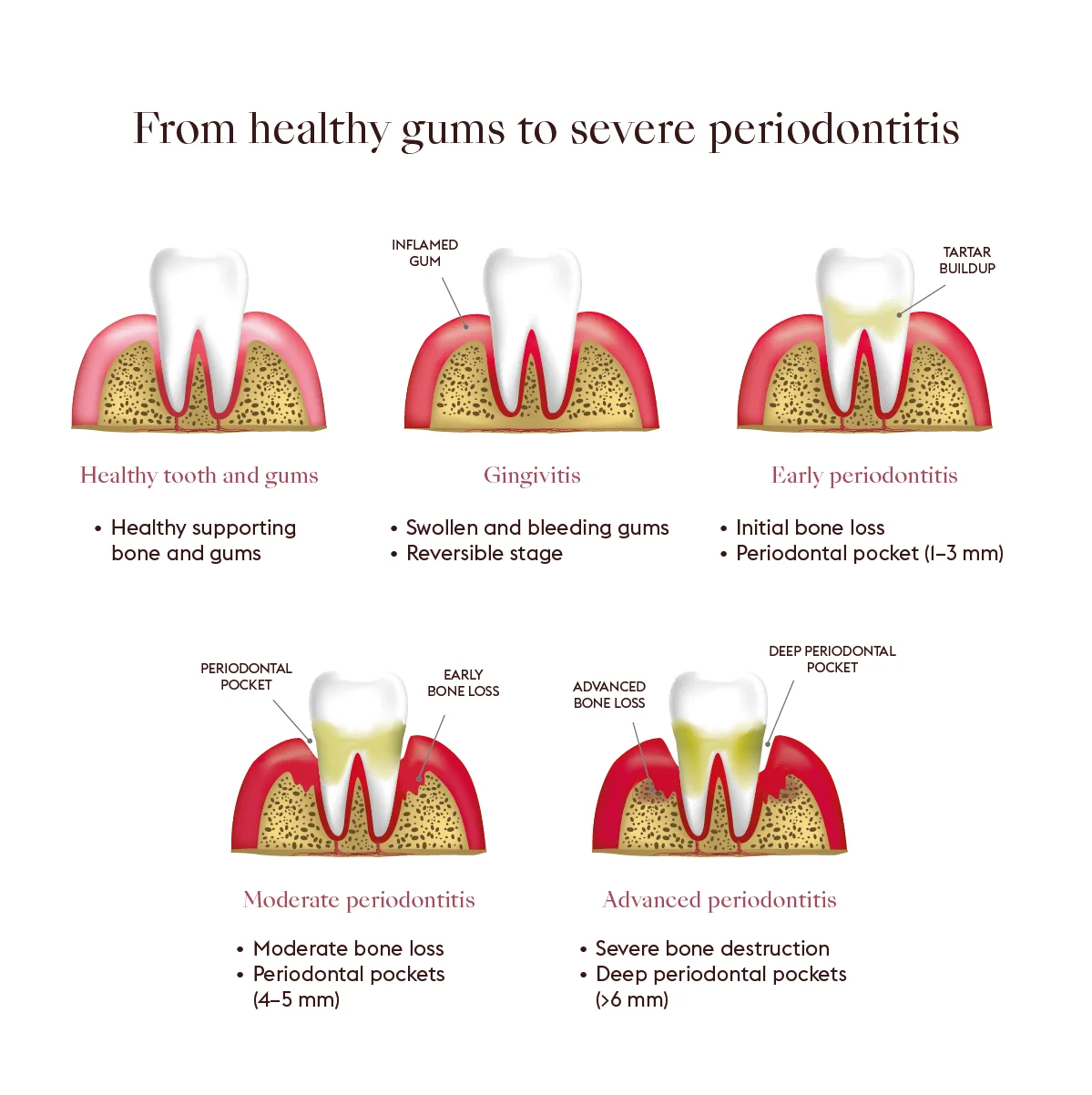
The bacteria involved are well identified
The pathogenic biofilm is organized around a few key species: Porphyromonas gingivalis, Tannerella forsythia, and Treponema denticola, along with Aggregatibacter actinomycetemcomitans and Fusobacterium nucleatum.
These bacteria share three properties that explain their impact on the whole body. They evade the local immune response. They destroy the supporting tissues of the tooth. And they repeatedly enter the bloodstream during everyday brushing or chewing.
Warning signs
Watch out in particular for:
- Gums that bleed when brushing or flossing
- Persistent bad breath despite proper hygiene
- Red, swollen, or receding gums
- Teeth that seem to move or drift apart
- Visible tartar, especially behind the lower incisors
None of these signs are painful at first, and that is precisely the problem: periodontitis progresses silently for years. If your gums bleed regularly, it is never normal.
What research shows in women
The most cited work remains an Australian study involving 3,416 pregnancies. In women with periodontal disease, the average time to conceive was 7.1 months, compared to 5.0 months in others (Hart et al., Human Reproduction, 2012). Among those who took more than a year to conceive, 34.9% had periodontal disease, compared to 25.7% in others. However, a subgroup analysis qualifies this result: the association was not found in Caucasian women in the cohort, which leaves the role of other factors open.
A Finnish team followed 256 women trying to conceive. Porphyromonas gingivalis was detected in 8.3% of those who did not conceive, compared to 2.1% of those who succeeded (Paju et al., Journal of Oral Microbiology, 2017). Women carrying the bacterium with a strong immune response were less likely to conceive over the study period, with a wide margin of uncertainty around this result.
Other studies find poorer gum health and more tooth decay in women with unexplained infertility, as well as links with polycystic ovary syndrome and endometriosis, two conditions in which inflammation already plays a central role. A Japanese study published in 2025 goes further into the mechanism: it found higher antibody levels against P. gingivalis in infertile women and, in an animal model, changes in the uterus and its hormone receptors.
First appointment
Assess your gum health
A periodontal examination tells you in a single visit whether there is a source of inflammation and whether it should be treated before going further.
Book an appointment →What research shows in men
The male side is less familiar to the public, even though it is at least as well documented. A systematic review published in 2025 gathered nine studies and 1,386 participants on the link between periodontitis and sperm quality (BMC Oral Health, 2025).
The findings can be summarized across four parameters.
| Semen parameter | What studies find | Level of evidence |
|---|---|---|
| Progressive motility | Reduced in men with severe periodontitis | Consistent across several studies |
| Morphology | Lower percentage of normal forms as oral inflammation increases | Consistent |
| DNA fragmentation | Increased in men with periodontitis | Two convergent studies |
| Count and concentration | Contradictory results depending on the study | Inconclusive |
A case-control study of 192 men approaches the question from the other end and reaches the same conclusion: moderate to severe periodontitis was present in 33.3% of those with an abnormal semen analysis, compared to 17.8% of controls, a 3.4-fold higher risk after adjustment (Tao et al., Oral Diseases, 2021).
Older studies already pointed in this direction, linking oral hygiene to sperm count, or describing poorer gum health and more tooth decay in men with unexplained infertility. The authors of the 2025 review note that they could not perform a meta-analysis because the protocols were too heterogeneous.
These are precisely the parameters that fertility teams try to improve before IVF or ICSI. Sperm DNA fragmentation, in particular, is a marker closely monitored by reproductive medicine teams.
Low-grade inflammation, the common mechanism
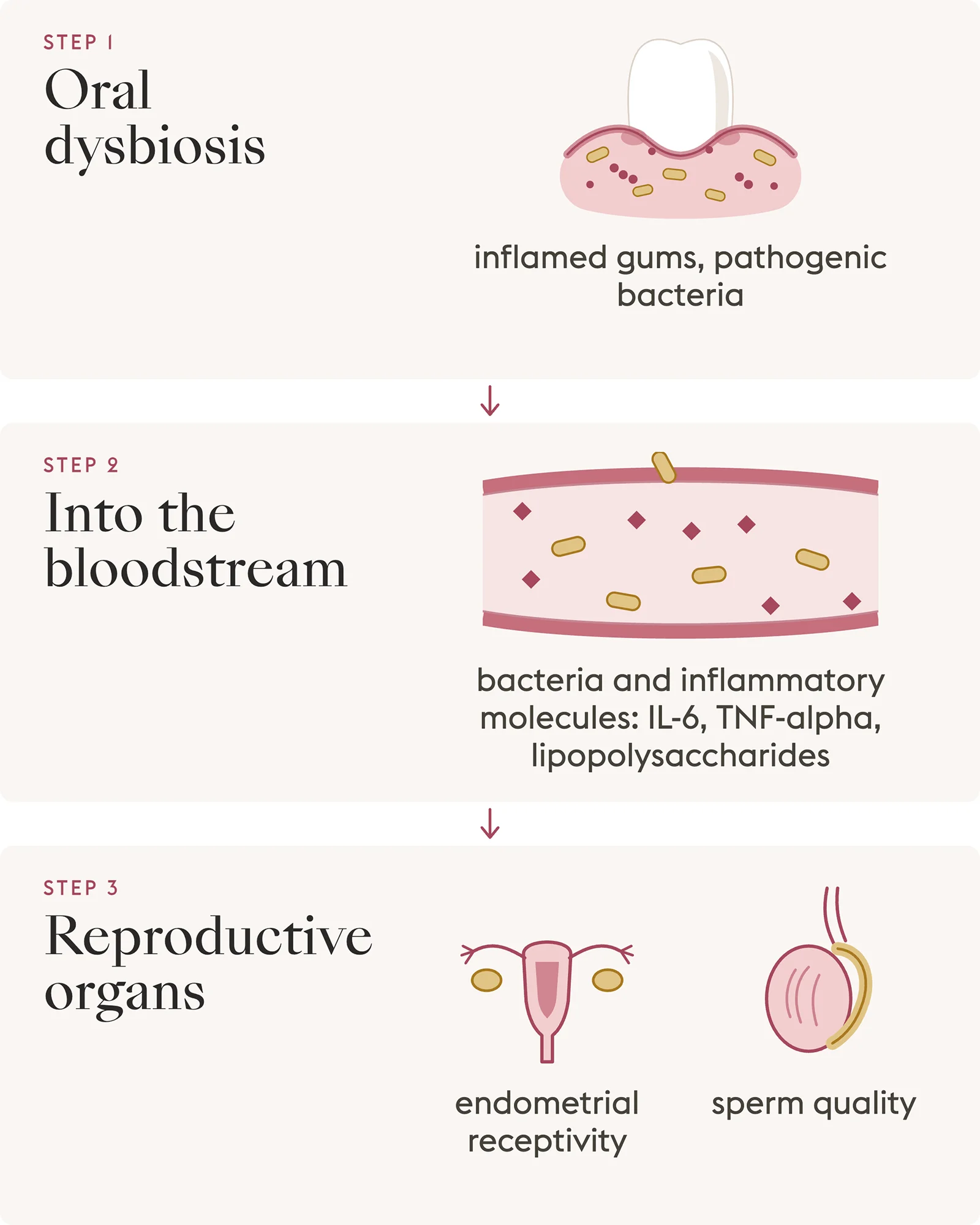
All these observations point to the same explanation. A mouth in dysbiosis constantly produces inflammatory messengers (interleukin 6, TNF-alpha) and bacterial fragments called lipopolysaccharides. These molecules leave the mouth via the blood and lymph, sustaining a low-level but persistent inflammation throughout the body.
This mechanism is already well established for diabetes, cardiovascular diseases, and certain neurodegenerative diseases. The same pattern appears to affect the reproductive organs: altered endometrial receptivity, disrupted folliculogenesis and spermatogenesis, and, when pregnancy occurs, an increased risk of premature birth or low birth weight, the best-documented link of all those mentioned here.
This is also why dental follow-up is recommended during pregnancy, and not only before. I explain what to do in the article on dental hygiene during pregnancy. For a broader look at how the oral flora affects the rest of the body, see our article on the oral microbiome and global health.
Why think as a couple rather than as individuals
Partners in a couple share their oral flora. This changes how the issue should be approached.
A Dutch study involving twenty-one couples measured this transfer. A ten-second intimate kiss moves an average of 80 million bacteria from one partner to the other, and the similarity between the two salivary microbiomes increases with the frequency of kissing (Kort et al., Microbiome, 2014).
The practical consequence is simple. Treating only one of the two partners exposes them to recolonization by the other. In a couple, a periodontal imbalance in one maintains a common bacterial and inflammatory environment. This is why it makes more sense to assess both partners than to treat only one.

The oral health assessment during fertility treatment in Geneva
In Switzerland, in vitro fertilization is not reimbursed by basic insurance. A complete cycle, including medication, costs around CHF 10,000, paid by the couple. Dental care is also not covered by basic health insurance (LAMal), with a few exceptions, as I explain in our guide on reimbursement for dental care in Switzerland. But the amounts are not on the same scale. A check-up consultation is CHF 100 at the clinic, scaling and polishing starts at CHF 150, and any more extensive treatment plan is quoted in advance. Details can be found on our rates page.
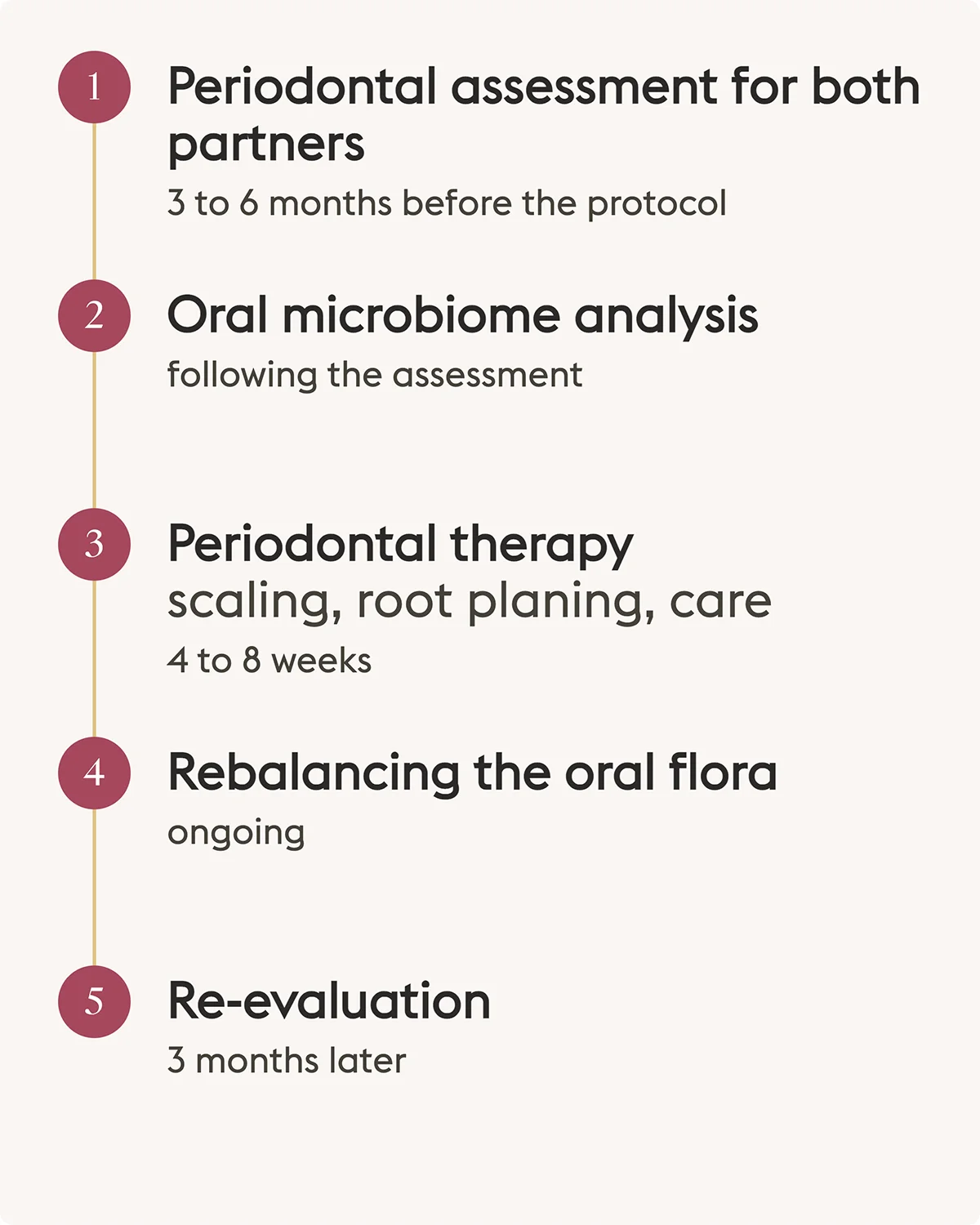
In terms of timing, here is how it works in practice.
| Step | When | Objective |
|---|---|---|
| Full periodontal assessment of both partners | Ideally 3 to 6 months before fertility treatment starts | Measure pockets, identify sources of infection, assess inflammation |
| Oral microbiome analysis if needed | After the assessment | Identify dominant pathogenic species |
| Deep cleaning: scaling, root planing, treatment of cavities | Over 4 to 8 weeks | Remove the harmful biofilm and sources of infection |
| Rebalancing the flora and tailored hygiene | Ongoing | Restore a protective flora and prevent recolonization |
| Reassessment | 3 months after treatment | Check stability before or during fertility treatment |
The idea is not to add another step to an already heavy journey. It is about ruling out, in advance, a modifiable inflammatory factor at a time when you are trying to maximize every chance. A non-surgical periodontal treatment takes place at the clinic, under local anesthesia, and is scheduled ahead of fertility treatment, in coordination with your fertility team.
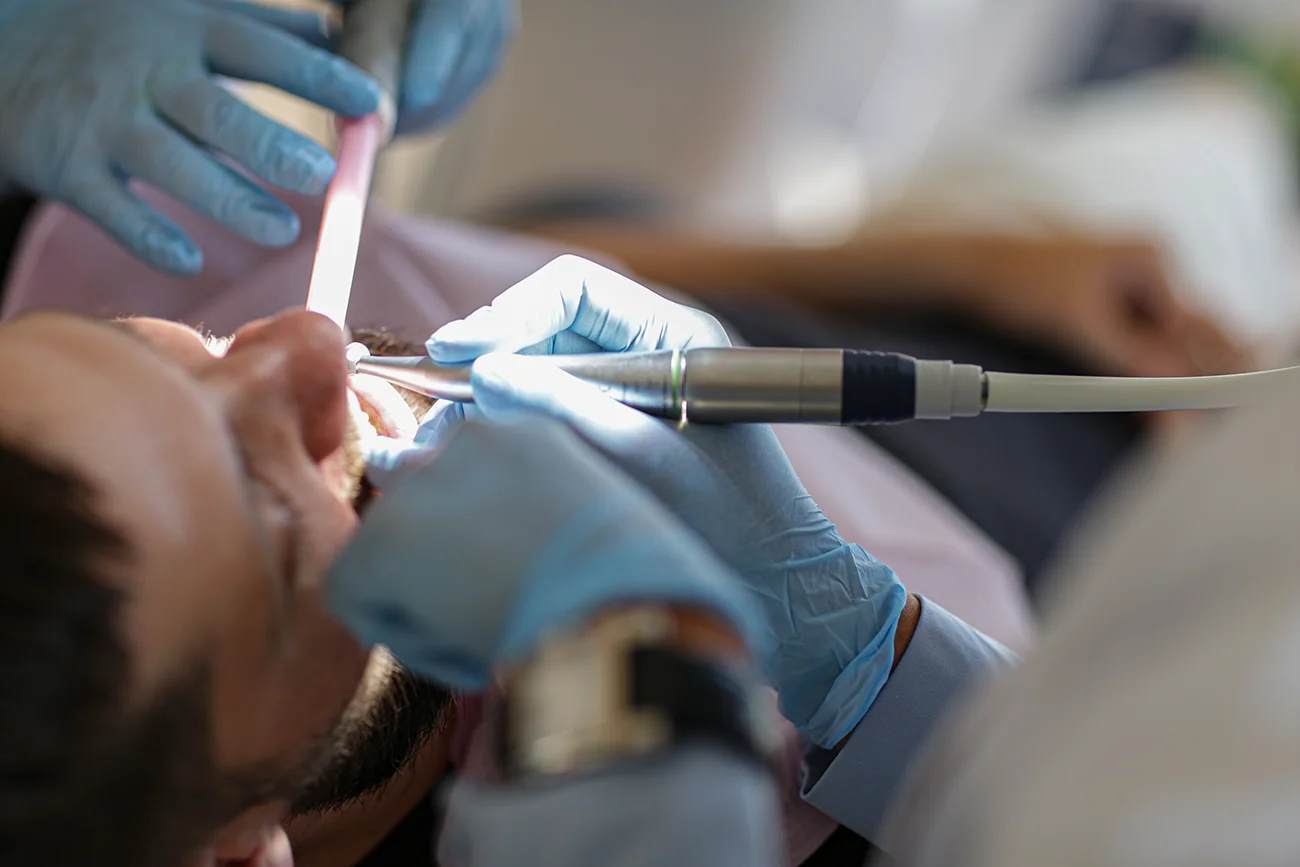
At the clinic, oral microbiome analysis and rebalancing protocols are part of our approach. The principle remains the same as for the rest of general dentistry: treat the cause, not just the symptom. Daily care then relies on simple habits, detailed in our oral hygiene rules and supplemented by regular professional hygiene follow-up.
Oral health assessment • Personalized quote
From CHF 100.-
First consultation with examination, detailed quote, and treatment plan, without obligation.
Book an appointment →Price depends on your clinical situation • Payment plans available
What this approach does not promise
It is important to be clear about what is known, because this subject lends itself to shortcuts.
Available studies establish associations. They do not yet demonstrate that periodontal treatment alone increases the chances of pregnancy. A critical review published in 2026 in the Journal of Dental Research states it bluntly: the biological mechanisms are plausible, the signals convergent, but the evidence remains largely associative, and the authors warn against premature expectations of a treatment benefit.
What can be said honestly: treating periodontitis is useful in itself, whether or not you are trying for a baby. It is an action whose general benefit is established, whose cost is modest compared to fertility treatment, and which removes an inflammatory factor whose role is seriously suspected. Nothing more, nothing less.
Frequently asked questions
Should a dental assessment be done before IVF?
It is not a required step in fertility treatment in Switzerland. It remains relevant: the assessment is quick, any treatment takes place over a few weeks, and it does not interfere with the medical protocol.
Is gingivitis enough to cause a problem?
Gingivitis is a superficial and reversible inflammation of the gums. It is the stage that precedes periodontitis, which affects the bone. Gingivitis treated early is not a concern, but left untreated, it progresses in some patients to a deeper form.
Does my partner really need to be examined too?
It is best, for two reasons. Sperm quality is associated with periodontal status in several studies. And because partners share bacteria, treating only one of them gives less lasting results.
Is the treatment painful?
Root planing is performed under local anesthesia. A standard scaling does not require it. Discomfort is generally limited to sensitivity for a few days.
How long before seeing an effect on inflammation?
Inflammatory markers generally decrease within two to three months after treatment, provided that daily hygiene is maintained. This is the timeframe we use for reassessment.
An assessment before starting
The link between oral health and fertility will never replace a gynecological or andrological assessment. It complements it. If you are trying for a baby, especially with fertility treatment, and your gums bleed or your last scaling was more than a year ago, an assessment is worth doing. It rules out a hypothesis, or it reveals something that no one else has looked at.
Make an appointment with Dr Bernard Kurdyk for a periodontal assessment and an oral microbiome analysis as a couple. Book your consultation.
Are you a gynecologist, midwife, reproductive biologist, or fertility specialist and would like to refer a couple for an oral health assessment? Contact us; we coordinate care and send a written report to the referring practitioner.