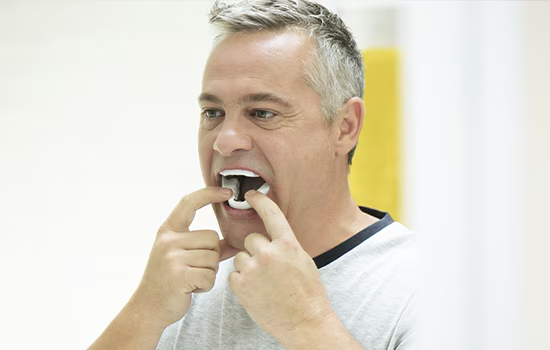
A Mandibular Advancement Device (MAD) is a medical device used in the treatment of sleep-related breathing disorders, such as snoring and certain forms of obstructive sleep apnea.
It is a custom-made appliance worn at night, designed to hold the lower jaw in a slightly forward position to prevent obstruction of the upper airway during sleep.
By promoting a freer airflow, the MAD helps reduce episodes of snoring and apnea. This treatment is particularly indicated for mild to moderate sleep apnea, or for patients who do not tolerate or do not wish to use continuous positive airway pressure (CPAP) therapy.
The appliance is individually designed and adjusted by the dentist to ensure an optimal balance between therapeutic effectiveness, comfort, and long-term tolerance.
During sleep, the muscles of the upper airway naturally relax. In some individuals, this relaxation leads to a narrowing, or even partial or complete obstruction, of the airway.
The position of the lower jaw plays an important role in this phenomenon. When it recedes during the night, the tongue and soft tissues can obstruct the airways, causing vibrations responsible for snoring or breathing pauses called sleep apnea.
Anatomical, functional, or lifestyle-related factors can contribute to these disorders, the severity of which varies from patient to patient.
Sleep apnea is a condition that requires a medical diagnosis made by a sleep medicine specialist, usually with the help of specific examinations.
Before this diagnosis, it is possible to assess a potential risk using a simple screening questionnaire. This questionnaire helps estimate the likelihood of having sleep apnea based on common criteria such as age, weight, neck circumference, or snoring.
This questionnaire does not constitute a diagnosis and does not replace medical advice. It is a useful first step to determine if consulting a sleep specialist is recommended.
The mandibular advancement device is part of the management of sleep-related breathing disorders, particularly mild to moderate sleep apnea and chronic snoring.
When sleep apnea is diagnosed by a specialist physician, the MAD can be prescribed as a therapeutic option. It is then integrated into a coordinated follow-up between the dentist and the sleep physician, with potential insurance coverage depending on current conditions.
For patients with snoring without sleep apnea, the MAD can also be offered without a prior medical prescription. A three-month trial period allows for evaluation of the treatment’s effectiveness and tolerance. Potential reimbursement terms are explained during the consultation.
In all cases, the treatment decision is based on an individualized clinical evaluation and appropriate follow-up.
The management of sleep-related breathing disorders is not limited to the placement of a device. Regular follow-up is essential to evaluate the treatment’s effectiveness and ensure its good tolerance.
Check-ups are performed at the dental practice to adjust the appliance if necessary. Validation of effectiveness is strongly recommended after three months, in collaboration with the sleep physician.
Without appropriate treatment or follow-up, sleep disorders can persist and impact quality of life and general health.
A short questionnaire allows you to assess your risk in a few minutes.
Insurance reimbursement is only possible for diagnosed sleep apnea prescribed by a pulmonologist or an ENT specialist in sleep medicine. The clinic offers an initial eligibility consultation and can refer you to a trusted sleep physician. In cases of snoring without apnea, the appliance can be provided with a 3-month trial period and a possibility of partial reimbursement depending on conditions.
We conduct a comprehensive clinical evaluation, including a discussion about your sleep, as well as an extra-oral and intra-oral examination to confirm treatment compatibility.
Impressions and measurements are taken in a mandibular advancement position defined by the dentist. The case is then sent to the laboratory for custom fabrication.
Upon receipt, the appliance is tested in the mouth and adjusted to optimize comfort, stability, and tolerance. Further adjustments may be necessary.
A check-up is performed at the practice to adjust the appliance, verify adaptation, and, if necessary, coordinate follow-up with the sleep physician.
Validation is strongly recommended after three months with the sleep physician to confirm improvement in snoring and/or apnea and to adapt management if necessary.
Diagnosed Apnea: reimbursement possible if prescribed by a pulmonologist/sleep ENT.
Snoring without Apnea:
3-month trial, return possible with partial reimbursement depending on conditions (explained during consultation).
Insurance reimbursement is only possible if sleep apnea has been diagnosed and if the appliance is prescribed by a pulmonologist or an ENT specialist in sleep medicine. The exact terms depend on your insurance and are explained during the consultation.
The appliance is custom-made to ensure good comfort. An adaptation phase is sometimes necessary at the beginning. Adjustments can be made at the practice if needed.
In certain cases of mild to moderate sleep apnea, or when CPAP is poorly tolerated, the appliance can be an alternative or a complement. The decision is made in collaboration with the sleep physician.
The first effects can be felt quickly, but validation of effectiveness is strongly recommended at three months, in collaboration with a sleep medicine specialist.
To better understand sleep apnea, snoring, and management solutions, we invite you to consult our dedicated article.