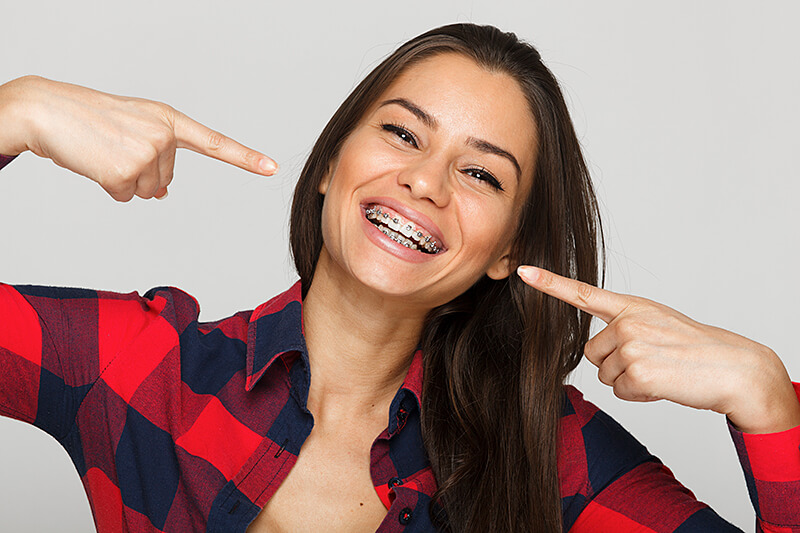
If you wear fixed orthodontic appliances (braces), a few additional steps are necessary to properly clean your teeth. Indeed, food debris has the unfortunate habit of getting stuck in small corners and crevices, thus promoting the formation of dental plaque.
Our orthodontist in Geneva, Dr. Victoria Masserey Klimovich, explains how to properly brush your teeth with fixed braces and what tools you need to do so. The good news: these tips are easy to implement and quickly become routine!
Cleaning Braces Is Important
Proper cleaning of braces is essential for optimal oral health. This prevents not only discoloration of the braces themselves, but also discoloration of your teeth. The components of fixed braces, such as brackets, wires, and elastics, attract food debris, which can get stuck as easily as in interdental spaces. Cavities or tooth decalcification can be avoided by taking the following measures:

1 – Rinse your mouth vigorously with water three to four times a day to remove any food accidentally caught in the braces.
2 – Next, teeth must be thoroughly brushed. I recommend brushing your teeth more frequently when wearing braces, as food debris can accumulate inside and behind the appliance, which can lead to the formation of tartar, cavities, and especially tooth decalcification, which is unfortunately permanent.

3 – Use a medium or electric toothbrush.
4 – When brushing your teeth, make sure to brush the braces themselves as well as all around the braces.
5 – After brushing your teeth, hard-to-reach areas between the braces and behind the wires must be cleaned with an interdental brush and/or dental floss.
6 – Rinse your mouth with a mouthwash solution every evening after brushing your teeth and before going to bed.
Using Dental Floss and Interdental Brushes
Once a day, floss (or help your child do so, as it can be difficult with braces). Flossing helps remove food debris and plaque at and below the gum line. Otherwise, this debris could contribute to tartar buildup and cause an unpleasant odour. Flossing also helps reach areas of the teeth that are difficult to access with a toothbrush.
If you wear braces or any other orthodontic appliance, here are the materials you need to use to maintain good dental hygiene:
Waxed dental floss, as it is less likely to catch on braces.

Optional: dental floss with threader (superfloss). Very effective with orthodontic appliances.
An interdental brush to effectively clean hard-to-reach spaces.
Optional: water flosser (Waterpik or dental water jet). Everything you need to know about using a Waterpik

Dr. Patrick Rodrigues Lopes
Orthodontist. DentalGeneva, Geneva city center.
Professional Teeth Cleaning for Optimal Dental Appliance Hygiene
Even during orthodontic treatment, I recommend visiting the dentist every six months to rule out any cavities and have your teeth cleaned by a dental hygienist. They will show you the areas of the teeth that require special attention and explain the best way to clean them.
Cleaning Braces Outside the Home
At home, it is easy to keep your teeth clean. However, at the office or if your child is at school or on a school trip, it becomes less obvious. The solution is to use (or give your child) a travel toothbrush and toothpaste to take along!