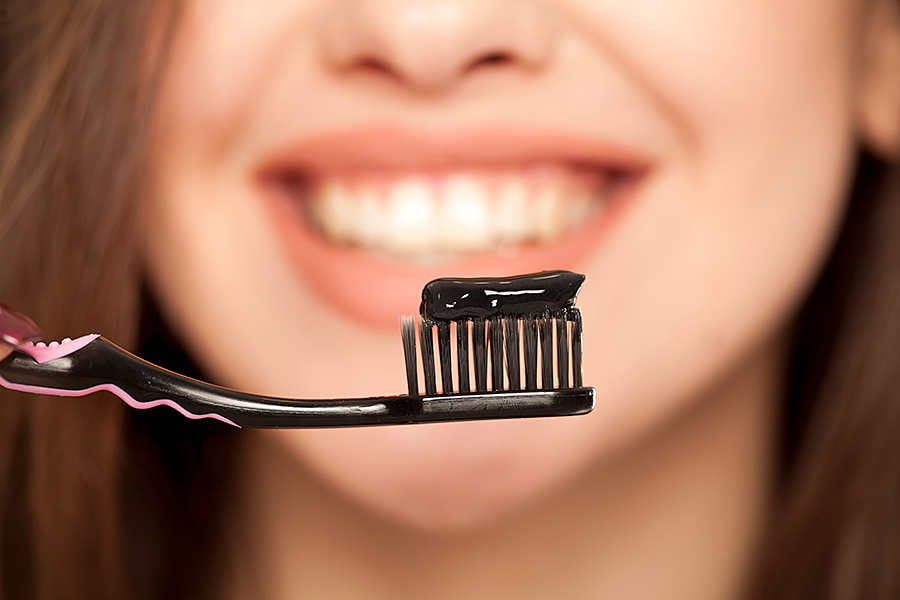
For some time now, they have been everywhere: photos of people with black toothpaste on their teeth. At first glance, these images may seem strange, but behind the black toothpaste lies the latest trend in dental care: activated charcoal toothpaste. In this article, I invite you to explore the principle of activated charcoal in dental care and answer the following question: is activated charcoal truly healthy for your teeth?
What is activated charcoal?
Let’s start at the beginning: What is activated charcoal? Activated charcoal, also known as activated carbon, is generally obtained by carbonizing coconut shells, ash or poplar wood, olive pits, peat, or peanut shells, heated to temperatures between 600°C and 900°C.
The addition of air, steam, and oxidizing gases gives it an exceptional porous structure with a surface area of up to 1,500 m²/g and the appearance of a sponge.

The principle of activated charcoal is that it acts like a sponge, absorbing and trapping substances within its pores. It is not absorbed by our body but can bind toxins, chemicals, or odorous molecules to its surface.
Activated charcoal has been used in water and air filtration since antiquity, and Hippocrates, the father of medicine, used it for medicinal purposes.
Doctors administer activated charcoal in cases of accidental chemical ingestion. It also removes microbes and their toxins from the intestines during intestinal and digestive disorders.

Beware of the negative effects of activated charcoal
One type of activated charcoal commonly used in black toothpastes is carbon black. The International Agency for Research on Cancer classifies carbon black as potentially carcinogenic to humans. To what extent this applies to the quantities used in black toothpaste remains to be studied.
Dangerous polycyclic aromatic hydrocarbons can also be produced during the production of activated charcoal. To ensure these do not end up in black toothpaste, manufacturers must clean the charcoal. As a consumer, you can ask the manufacturer directly if this is part of their process.

How effective is activated charcoal in dental hygiene?
Due to the adsorption process explained above, one might assume that tooth stains are gently removed by brushing with activated charcoal toothpaste, but there are currently no independent scientific studies that can confirm this effect.
In reality, tooth whitening with activated charcoal toothpaste occurs through friction. The porous and granular structure of black toothpaste acts as if the teeth were being rubbed with sandpaper. Regular use could therefore whiten teeth through abrasion.
Is activated charcoal healthy for your teeth?
RDA is a general value for toothpastes that indicates the intensity of dentin abrasion. The greater the abrasive power, the better the cleaning power. Conversely, if it is too high, it can cause damage to the dentin and enamel. An RDA below 80 is recommended for daily toothpaste use.
Often, activated charcoal toothpastes have a slightly high RDA value. Consequently, long-term use of activated charcoal toothpaste may gradually increase tooth sensitivity to heat and cold. Furthermore, the permanent use of activated charcoal toothpaste can quickly lead to new unwanted staining, as pigments can accumulate more easily on the abraded tooth surface.
Conclusion on dental care with activated charcoal
As spectacular as the use of black paste may be, the topic of dental care with activated charcoal unfortunately presents more negative aspects than positive ones. Due to the porous consistency of the toothpaste, brushing with activated charcoal toothpaste is very aggressive on the teeth. The friction attacks the tooth enamel, which may whiten the teeth initially, but is ultimately harmful to the teeth in the long run.
If you suffer from tooth discoloration and desire bright white teeth, we recommend professional whitening at our practice instead. Thanks to our tooth-friendly whitening process using BlancOne technology, you can achieve white teeth for up to a year.