Have you lost a tooth, or have you been told one needs to be extracted? This is a more common situation than one might think, and it’s normal to have many questions. How much does a dental implant cost in Geneva? How is it placed? Will my insurance cover it?
In this guide, I explain everything you need to know before making your decision, including the fees charged at Dental Geneva and practical information on coverage in Switzerland.
What is a dental implant?
A dental implant is a small titanium or zirconia screw that the dental surgeon inserts into the jawbone. It replaces the root of the missing tooth. Once integrated into the bone (a natural process called osseointegration), the implant receives an abutment, then a ceramic crown that replicates the appearance and function of a natural tooth.
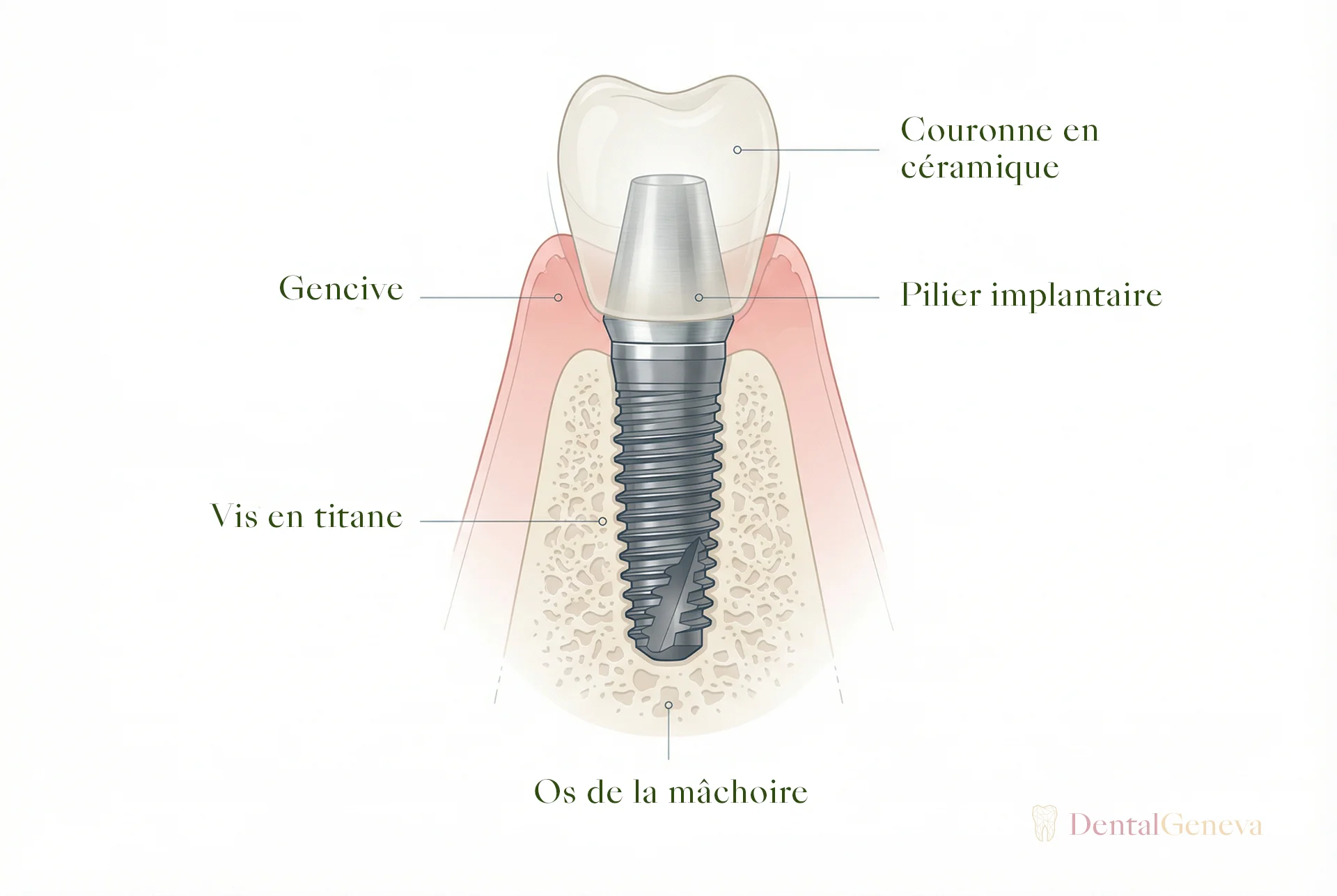
Unlike a bridge, an implant does not require reshaping the adjacent teeth. And unlike a removable denture, it is fixed, stable, and comfortable: you forget it is there.
The lifespan of a dental implant generally exceeds 20 years when properly maintained, with a success rate greater than 95% according to long-term clinical studies (Pjetursson et al., Clinical Oral Implants Research, 2012).
Am I a candidate for
dental implants?
5 simple questions, immediate result
Take the test →Price of a Dental Implant in Geneva: 2026 Rates
Price transparency is one of our commitments at Dental Geneva. Here are the indicative rates for the main services related to implants.
| Service | Indicative Rate (CHF) |
|---|---|
| Single dental implant (placement + implant) | from 2,500.- |
| Crown on implant (ceramic/zirconia) | from 1,000.- |
| Complete implant (implant + abutment + crown) | from 3,500.- |
| Dental veneer | from 1,000.- |
| All-on-4 / All-on-6 (full arch) | upon personalized quote |
| Bone graft (if necessary) | upon personalized quote |
Several factors explain price variations: the number of implants, bone quality and volume (a bone graft adds a step and a cost), the type of crown (ceramic, zirconia), and the implant system used. At Dental Geneva, we work with the Nobel Biocare™ system, known for its reliability.
Good to know: the first consultation includes a complete clinical examination and a panoramic X-ray. You will leave with a detailed, no-obligation quote. Consult our prices page for more details.
How is an implant placed?
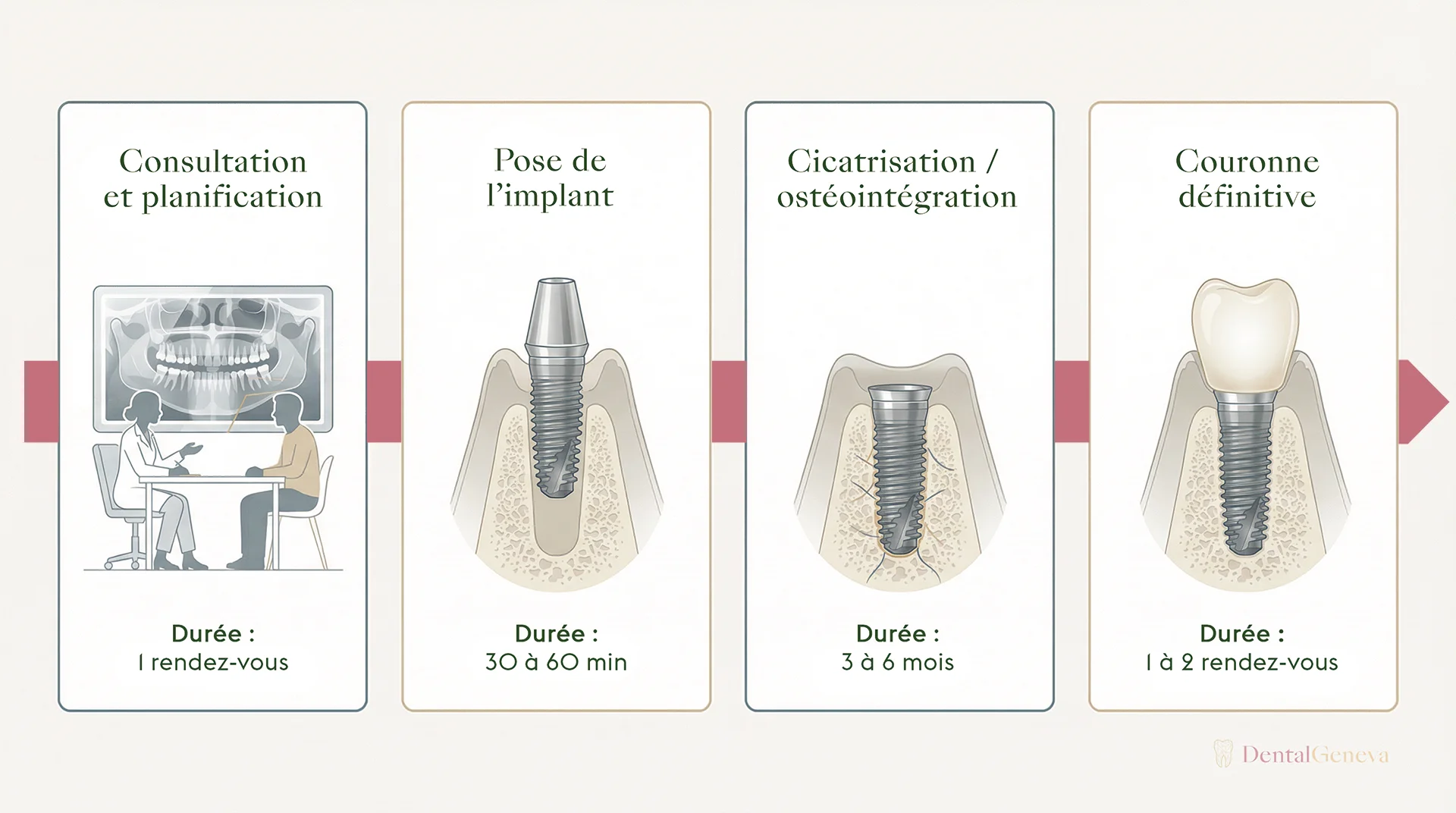
The procedure consists of several steps, spread over an average of 3 to 6 months.
Step 1: Consultation and planning
During the first appointment, we perform a thorough clinical examination and 3D imaging (CBCT). This X-ray allows us to measure the available bone volume and plan the ideal implant positioning.
Step 2: Implant placement
The procedure is performed under local anaesthesia. The dental surgeon inserts the titanium screw into the jawbone. The operation generally takes between 30 and 60 minutes per implant. Contrary to popular belief, placement is not very painful; most patients describe discomfort comparable to that of a simple extraction.
Step 3: Healing and osseointegration
For 3 to 6 months, the implant naturally integrates with the bone. A temporary prosthesis can be placed in the interim for aesthetic reasons, especially in the smile zone.
Step 4: Placement of the final crown
Once osseointegration is confirmed, the custom-made crown is fixed onto the implant abutment. The result is a natural-looking tooth, perfectly integrated into your smile.
Dr. Bruno Gauthier
Dentist, specialised in implantology, restorative and aesthetic dentistry. Dental Geneva, Geneva city centre.
Short implants: a minimally invasive alternative
When bone volume is limited, conventional techniques often required a bone graft, which is more invasive, longer, and more expensive.
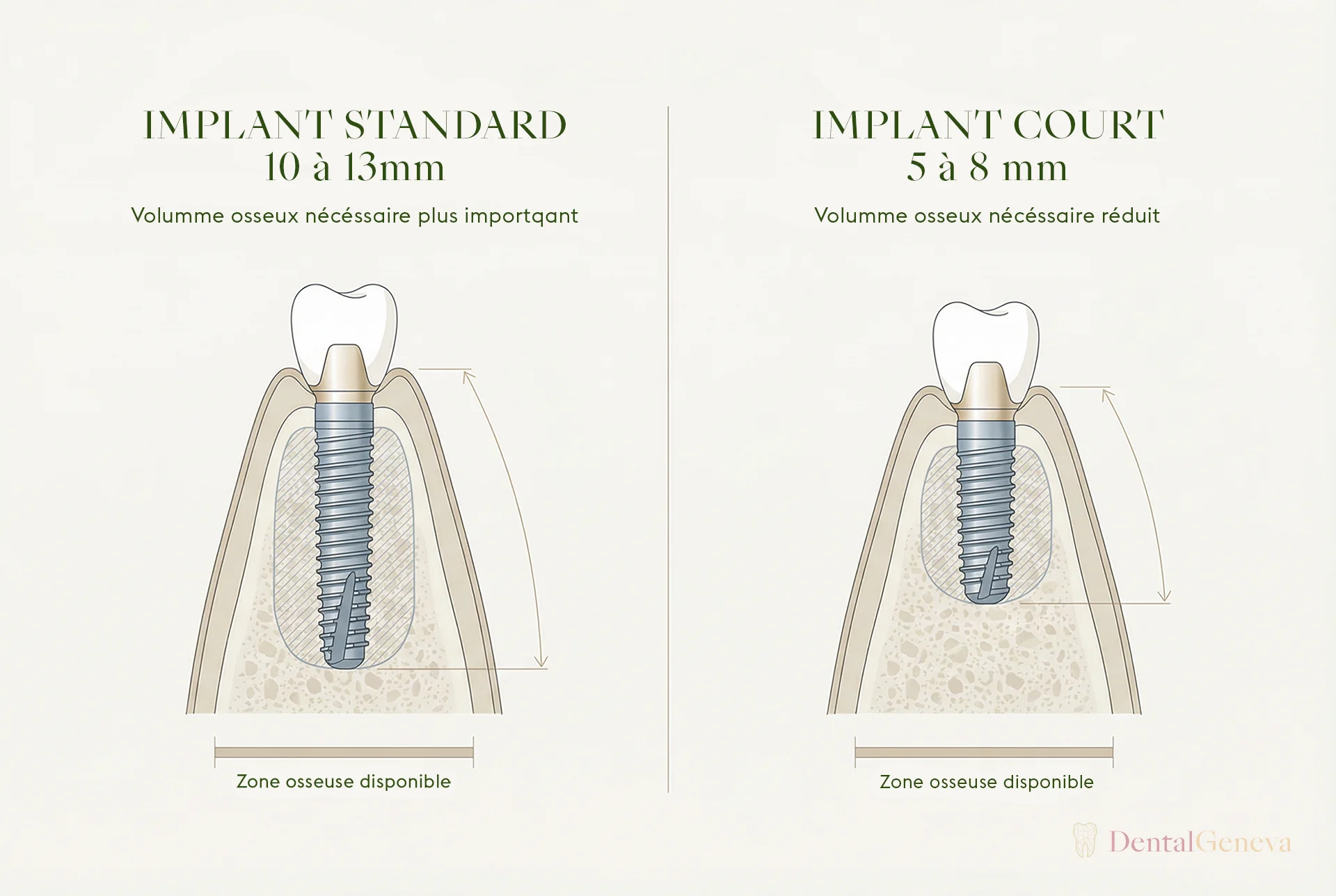
Short implants (5 to 8 mm) now offer a reliable alternative. Used for nearly 30 years, they show success rates equivalent to standard implants according to recent studies (Lemos et al., Journal of Dentistry, 2016). Their placement is simpler, faster, and often less expensive.
At Dental Geneva, we systematically evaluate this option when the patient’s anatomy allows.
All-on-4 and All-on-6: the solution for a full arch
If you have lost all or most of the teeth in a jaw, the All-on-4 or All-on-6 technique allows a complete prosthesis to be fixed on only 4 or 6 strategically positioned implants.
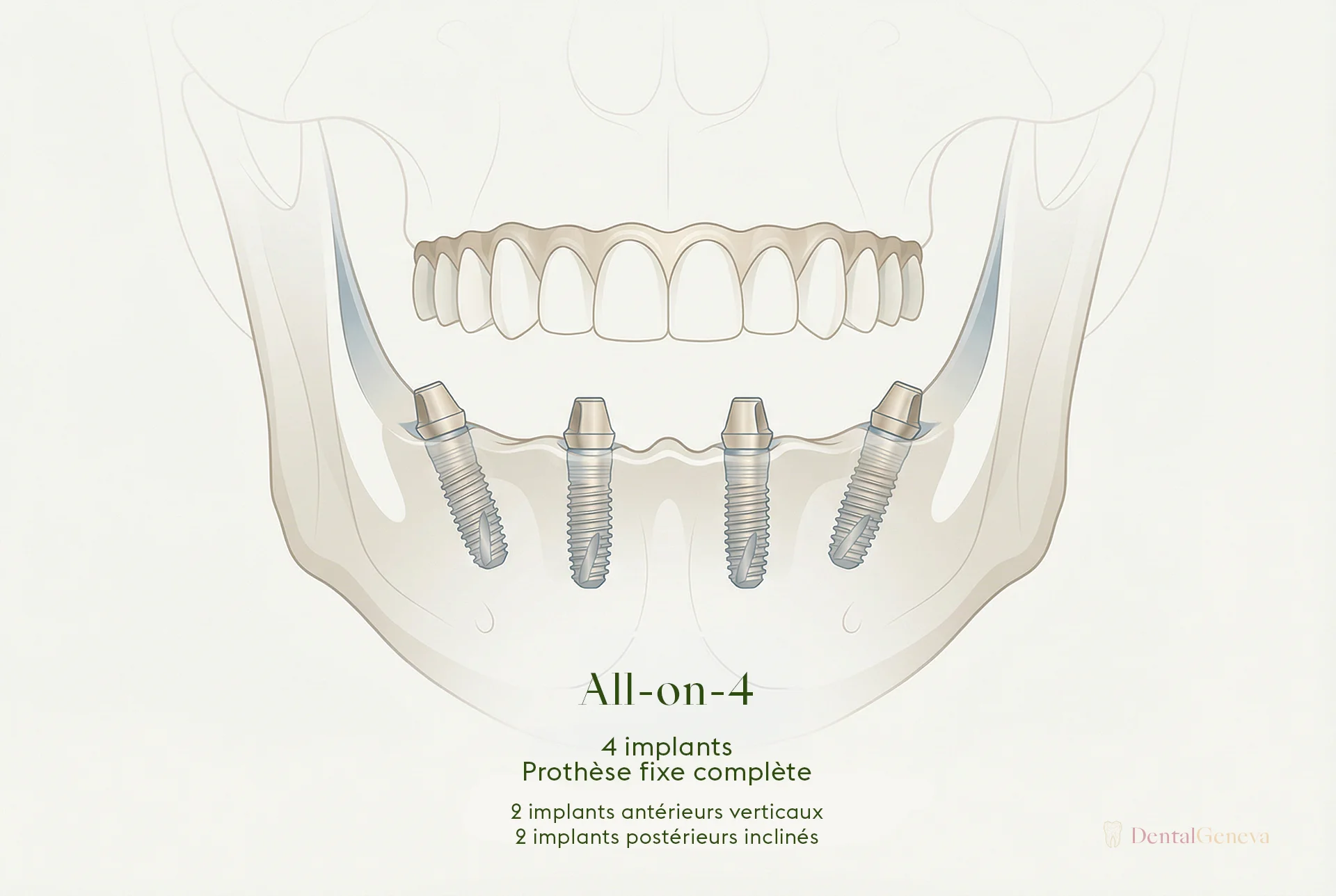
One of the major advantages: the possibility of placing a temporary prosthesis on the same day as the procedure. You leave the practice with functional and aesthetic teeth immediately.
Dr. Thierry Caro, oral surgeon and implantologist with over 25 years of experience, performs these procedures at Dental Geneva using the Nobel Biocare™ system. His expertise covers the most complex cases, including patients who have experienced bone graft failures.
Reimbursement and insurance in Switzerland
This is often the most frustrating question: basic insurance (LAMal) does not reimburse dental implants in Switzerland, except in cases of accident (LAA) or severe masticatory system disease.
Outside of these situations, reimbursement depends on your supplementary dental insurance. Most cover between 50% and 75% of costs, with a variable annual cap (CHF 1,000 to 5,000 depending on the contract). Some plans go up to CHF 10,000 or 15,000.
Beware of waiting periods: most insurers impose a waiting period of 12 to 24 months between subscription and the first coverage. It is recommended to subscribe to supplementary dental insurance before needing major treatment.
Our advice: request a detailed quote (which we will provide) and submit it to your insurance. At Dental Geneva, we also offer payment facilities.
Initial consultation with clinical assessment, 3D X-ray, and a detailed, no-obligation quote
Book an appointment →Frequently asked questions
Is implant placement painful?
The procedure is performed under local anesthesia, so you will feel nothing during placement. In the following days, moderate discomfort can be managed with common painkillers. Most of our patients resume their activities the next day. If you feel apprehension, discover our advice on fear of the dentist.
How long does a dental implant last?
With good hygiene and regular check-ups, an implant lasts an average of more than 20 years. The crown may require replacement after 10 to 15 years.
Am I a candidate for dental implants?
Most adults in good general health are eligible. Certain conditions (uncontrolled diabetes, heavy smoking) may require precautions. This is the purpose of the initial consultation.
Is there an age limit?
There is no upper age limit. Implants are successfully placed in patients aged 70, 80, and beyond.
What if I don’t have enough bone?
Several solutions exist: bone graft, sinus lift, or short implants which often avoid grafting.
When to consult?
If you have one or more missing teeth, if an extraction is planned, or if your removable denture no longer suits you, an implant assessment will allow you to explore the options adapted to your situation.
The earlier the consultation, the simpler the solutions: bone tends to resorb after an extraction, which can complicate placement if you wait too long.
Not sure whether implants are right for you? Complete our quick assessment questionnaire, 5 questions, 2 minutes, immediate results.
Book an appointment with Dr. Bruno Gauthier for a complete examination and a personalized quote. The first consultation includes a clinical assessment, a 3D X-ray, and a clear treatment plan.