
Your mouth is home to a living ecosystem of several hundred species of microorganisms: the oral microbiome. Long overshadowed by the gut microbiome, it protects your teeth and gums and contributes to the balance of your overall health.
When this balance is preserved, the oral microbiome helps contain inflammation. When it becomes disrupted, it is called dysbiosis, and the repercussions can extend beyond the mouth to affect the rest of the body. Taking care of it is therefore an act of health, not just for your smile.
In this article: what the oral microbiome is, the signs of an imbalance, its documented links to general health, its role in aging, and concrete steps to maintain it, including the comprehensive care offered in Geneva.
In this article
- What is the oral microbiome?
- Oral dysbiosis: the warning signs
- Mouth and global health: what the research shows
- Oral microbiome and aging: targeting inflammation
- Caring for your oral microbiome daily
- Comprehensive and personalized care in Geneva
- Frequently asked questions
What is the oral microbiome?
The oral microbiome is the collection of microorganisms (bacteria, viruses, fungi) that live permanently in the mouth: on the teeth, tongue, gums, and in the saliva. There are several hundred species, making it the second most diverse microbial community in the body, after the gut.
Far from being intruders, these microorganisms provide essential services. A balanced microbiome participates in the first stage of digestion, maintains and educates immune defenses, and limits the establishment of pathogenic bacteria by occupying the space.
Unlike the gut flora, which is relatively stable, the oral flora is an open ecosystem, on the front line of what you eat, drink, and breathe. This constant exposure explains its sensitivity to our lifestyle habits.
When balance is lost: dysbiosis
As long as this balance holds, aggressive species remain in the minority and under control. When it breaks down, it is called dysbiosis: pro-inflammatory bacteria take over and promote cavities, gingivitis, and periodontitis.
| Balanced microbiome | Microbiome in dysbiosis | |
|---|---|---|
| Gums | Pink, firm, no bleeding | Red, swollen, bleeding |
| Breath | Neutral | Heavy, persistent |
| Saliva | Abundant and protective | Reduced, dry mouth sensation |
| Consequence | Protected teeth and gums | Cavities, periodontitis, inflammation |
Oral dysbiosis: the warning signs
An imbalance in the oral microbiome sends signals that we tend to trivialize. Identifying them early allows for action before lasting damage occurs.
Watch out particularly for:
- heavy and persistent breath despite brushing;
- gums that bleed during brushing or spontaneously;
- red or swollen gums;
- receding gums or loose teeth;
- frequent dry mouth sensation;
- a coated or cracked tongue.
Bleeding gums or persistent bad breath are not just minor inconveniences: they are often the first signs of an imbalanced oral flora.
Mouth and global health: what the research shows
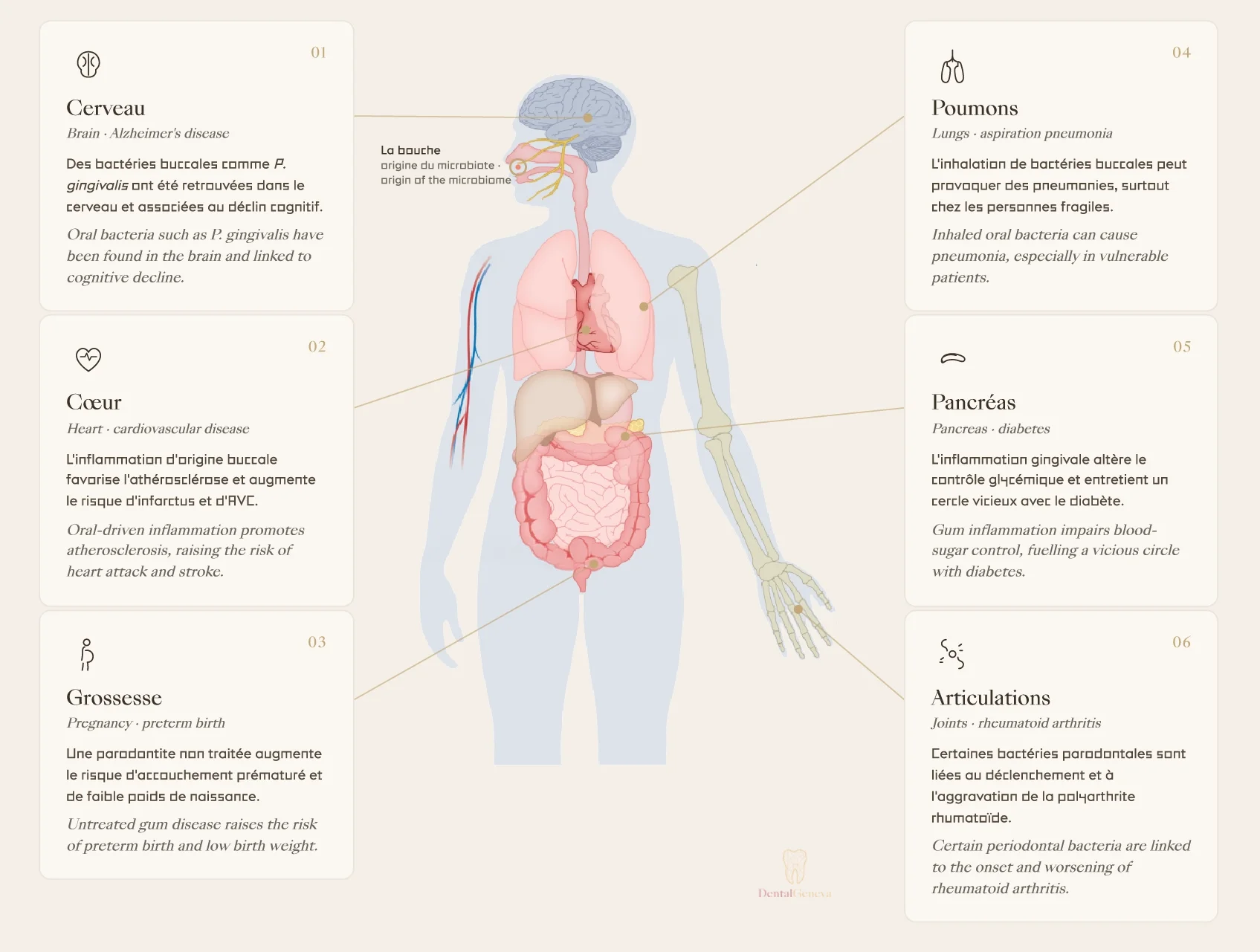
The mouth is a gateway to the rest of the body. In cases of periodontitis, bacteria and inflammatory molecules can enter the bloodstream and maintain inflammation elsewhere. This is the link that research has been exploring for years, as noted by the Microbiota Institute.
Heart and diabetes
Epidemiological studies associate periodontitis with an increased cardiovascular risk, via low-grade inflammation and the repeated passage of bacteria into the blood. Direct causality remains debated, as periodontitis and cardiovascular diseases share risk factors such as smoking, diabetes, and obesity. However, periodontal treatment improves certain cardiovascular markers, leading to recommendations for cross-prevention between the mouth and heart.
With diabetes, the link is better established and bidirectional: diabetes promotes periodontitis, and untreated periodontitis complicates blood sugar control. Each imbalance feeds the other.
An expanding field of research
Other avenues are the subject of active research. Oral dysbiosis is being studied in connection with certain neurodegenerative diseases: the bacterium Porphyromonas gingivalis, involved in periodontitis, has for example been found in research concerning Alzheimer’s disease and the oral microbiome. These links remain to be confirmed, but they reinforce a simple idea: taking care of your mouth means taking care of your health. We explore this further in our article on oral health as a window into your global health.
Oral microbiome and aging: targeting inflammation
Aging is accompanied by chronic low-intensity inflammation, which researchers sometimes refer to as inflammaging. This background inflammation accelerates tissue wear. A mouth in dysbiosis is a source of permanent inflammation.
Reducing this oral inflammatory load takes a burden off the body. A balanced microbiome limits local inflammation, supports better healing of oral tissues, and is part of a healthier aging process.
The stakes are therefore concrete: preserving your gums and your microbiome over the years is not just about your smile; it is a long-term health lever.
Caring for your oral microbiome daily

The oral microbiome responds directly to your habits: a few simple principles are enough to support it.
- Diet: prioritize fiber, fruits, vegetables, and fermented foods, and limit refined sugars that feed pro-inflammatory bacteria. Our guide to foods that are friends and enemies of your teeth details these choices.
- Hydration: drink enough water. Saliva is a natural protector of the teeth and oral flora.
- Regular but respectful hygiene: brushing twice a day and cleaning between the teeth remain the foundation, as reminded by our golden rules of oral hygiene. Reserve antiseptic mouthwashes for specific indications: used continuously, they unbalance the flora instead of protecting it.
- Tobacco: it dries out the mouth and depletes the flora. Quitting is one of the most effective actions for your microbiome.
- Probiotics and prebiotics: data on oral probiotics are still emerging. They can accompany care without replacing hygiene or professional follow-up.
- Professional follow-up: regular check-ups and professional scaling detect imbalances early. In Switzerland, as adult dental care is rarely covered by basic insurance (LAMal), prevention is also an economic choice.
Comprehensive and personalized care in Geneva
Once an imbalance is established (bleeding, receding gums, persistent bad breath), a one-off treatment is not always enough. A comprehensive approach seeks the cause, both local and general, rather than treating the symptom alone.
Concretely, the process is based on a complete diagnosis: clinical examination, reading of X-rays and, if necessary, analysis of the microbiome from oral samples, taking into account your general health status and lifestyle habits.
The treatment plan is then personalized. Rebalancing the microbiome often involves deep cleaning, supplemented if necessary by laser to disinfect and support tissue healing. Reducing factors that maintain inflammation (tobacco, stress, diet) and, when useful, providing prebiotics and probiotics help stabilize the flora over time.
This global perspective extends to the choice of materials. In a logic of long-term tolerance, restorations in biocompatible materials (composite, ceramic) are prioritized and, when indicated, the safe removal of old amalgams. This approach, sometimes called holistic dentistry or global dentistry—a dentistry attentive to the whole patient and based on evidence—is what the practice implements in the center of Geneva.
Frequently asked questions
Can the oral microbiome be rebalanced?
Yes. By correcting hygiene, diet, and risk factors, and with professional support if necessary, the oral flora can return to a favorable balance.
Are mouthwashes good for the microbiome?
Used occasionally and upon indication, they can help. In prolonged daily use, antiseptic mouthwashes deplete the flora and become counterproductive.
Does a healthy mouth really influence general health?
The strongest evidence concerns the link between periodontitis and diabetes, and the association with cardiovascular risk. Taking care of your mouth is part of a global health approach.
What is a global (or holistic) approach in dentistry?
It is a form of care that considers the mouth as a part of the body: it links oral health to lifestyle habits and general health, emphasizes prevention, and prioritizes biocompatible materials. At DentalGeneva, this approach remains evidence-based, without substituting recognized dental treatments.
In summary
If you notice bleeding, persistent breath, or receding gums, a check-up allows you to identify the source of the imbalance and act early.
Make an appointment with Dr. Bernard Kurdyk for an assessment of your oral health and a personalized treatment plan, within a global approach. Book your consultation.
Are you a practitioner (doctor, nutritionist, osteopath) and wish to refer a patient for periodontal care and microbiome rebalancing? Contact us for coordinated care.